Scratch is a coding technology wherein design thinking is used to create interactive stories, games, and animations (“Scratch – About”, 2020). Design thinking is the ability to complete a course of actions aimed at changing existing situations into preferred ones. Scratch can be used as an engaging cross-curricular activity in most subject areas, and draws on prior knowledge (Ling Koh et al., 2015). Students develop cognitive processes to think critically and creatively, reason systematically, and work collaboratively to improve the quality of their design products (Laurillard, 2012; Ling Koh et al., 2015). Additionally, teachers are able to explicitly model design thinking as well as creativity.
The following video is a demonstration on how to use Scratch.
It is clear that there are numerous facets to the program making it appealing to use, however, these can also be extremely difficult to understand. Therefore, explicit instruction is critical to maintain student engagement and effective learning through design thought processes.
There are 5 phases of the design thinking process:
1. Discovery
2. Interpretation
3. Ideation
4. Experimentation
5. Evolution
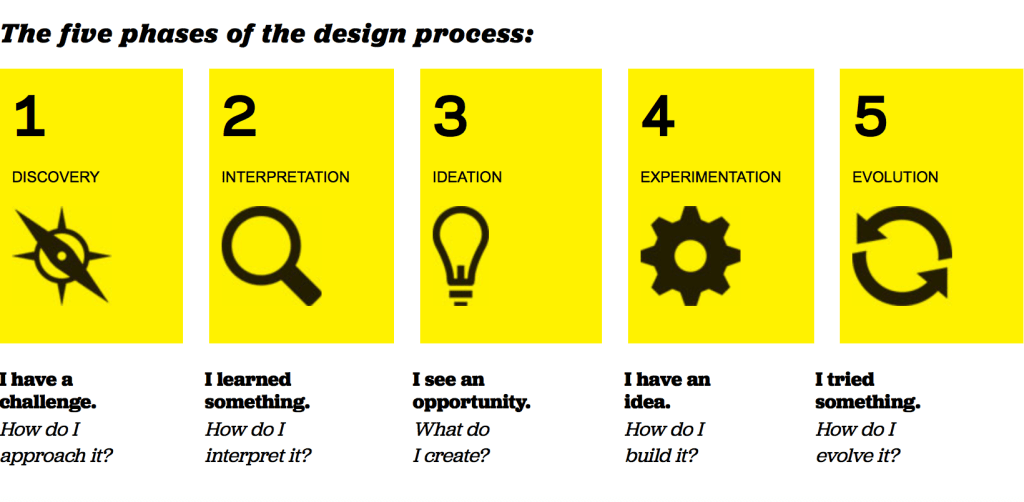
Technologies that are going to be integrated into the classroom must allow children to explore and solve problems using all 5 phases of the design process. By providing students with this opportunity, students are able to generate and develop their ideas. Thus, ensuring development of student’s character, and abilities to overcome ambiguous tasks to further broaden their educational experiences (Laurillard, 2012; Ling Koh et al., 2015).
As a teacher, I will be aiming to provide a supportive environment which encourages creativity and innovation through the design thinking phases, with the awareness of shifting pedagogical designs. I will try to constructively align goals for learning with what is taught, how it’s taught, and how it’s assessed. (Biggs, 2003; Fry 2009).
Snap!, another coding program similar to Scratch, however more complex, both achieve this through the endless possibilities of generating solutions for various problems. Students are able to use the design thinking process to continually evolve their design ideas and solve any problems within it.
Therefore, schools and their teachers should pay greater attention in embedding design thinking into learning outcomes as an integral part of education as they clearly promote the development of various cognitive processes to solve a wide variety of problems (Laurillard, 2012; Ling Koh et al., 2015).
Biggs, J. (2003). Teaching for Quality Learning at University. Buckingham: SRHE/OUP.
Fry, H. (2009). A handbook for Teaching and Learning in Higher Education: Enhancing academic practice. London: Taylor & Francis.
Laurillard, D. (2012). Teaching as a Design Science: Building Pedagogical Patterns for Learning and Technology. Routledge. ProQuest Ebook Central, http://ebookcentral.proquest.com/lib/mqu/detail.action?docID=957058.
Ling Koh, J., Chai, C., Wong, B., & Hong, H. (2015). Design Thinking for Education. Springer Singapore.
Scratch – About. Scratch.mit.edu. (2020). Retrieved 3 April 2020, from https://scratch.mit.edu/about.
 Elise's Blog
One thought on “Design Thinking within Education”