
Robotics is known for its presence in numerous fields of humanity such as medicine and manufacturing. However, over the years, robotics has slowly emerged into the education system and has undoubtedly transformed traditional pedagogical approaches. Robotics has the potential to foster creativity in students as they engage in higher-order thinking to generate and design innovatively complex solutions and products (Bers et al., 2014; Chalmers et al., 2012). With advances in robotics, students are no longer passive recipients of information, rather becoming co-constructors of their own learning. Students are now able to relate to and see the tangible and real-world applications of STEM (Jung & Won, 2018; Bower, 2020).
Bee-Bots are an easy-to-use robot specifically designed for younger aged primary students. They have only 7 buttons to input controls and are programmed to move up to 40 times. They are an excellent introductory robot to programming and coding skills in the classroom.
Bee-Bots are an easy-to-use robot specifically designed for younger aged primary students. They have only 7 buttons to input controls and are programmed to move up to 40 times. They are an excellent introductory robot to programming and coding skills in the classroom.
The simplicity of the Bee-Bot results in both strengths and weaknesses. The main strength is that there is no programming software, meaning students can use the Bee-Bots with minimal assistance once they learn the input controls. Additionally, aligning its usage with the curriculum of many KLAs is easy. Calculating steps and direction (maths), formulating a story (literacy) and making a mat (art) for the Bee-Bot to travel on is are some examples of excellent pedagogical uses; and therefore, creates a dynamic learning environment in which computational thinking is fostered (Atmatzidou & Demetriadis, 2015).
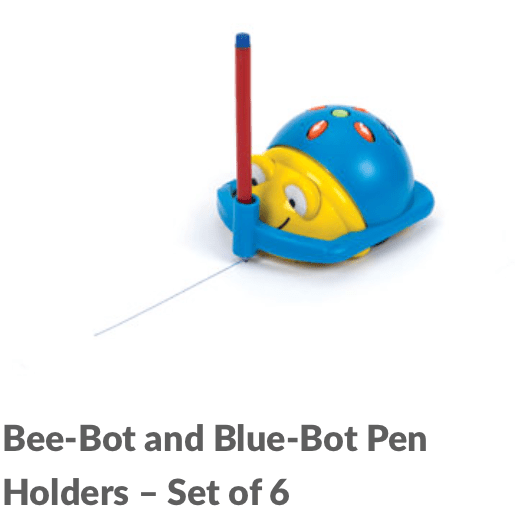
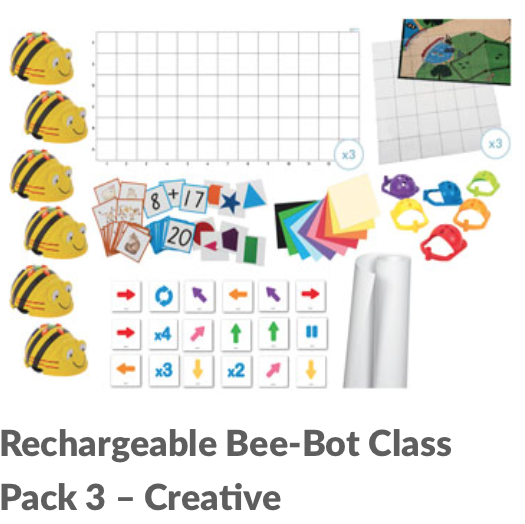
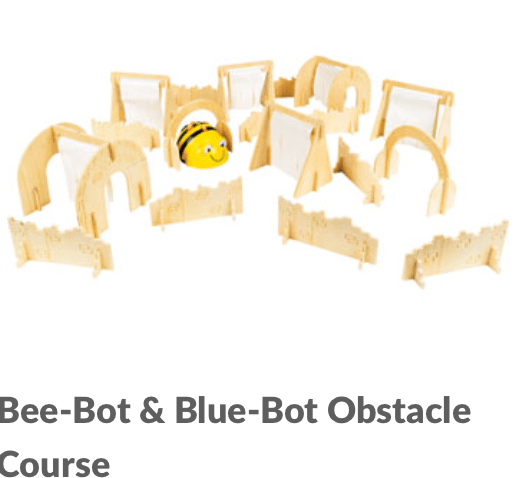
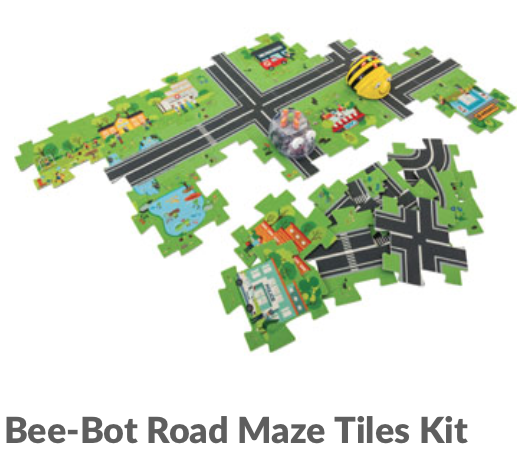
all photos via https://www.teaching.com.au/search?action=search&q=bee-bot
However, the main weakness, as a result of its simplicity, is the difficulty in creating complex and collaborative tasks. When students are no longer challenged, they become distracted and off-task behaviour increases. Whilst these are limitations, they can be easily reduced with careful consideration towards pedagogy. By creating a task which is highly complex and integrates content effectively, students are challenged and engaged in higher-order thinking, rather than the technology itself (Jung & Won, 2018; Alimisis, 2012).
The Bee-Bots effectively foster creativity and critical thinking even though it is so simply designed, allowing the user to practice and develop creative thinking strategies in order to problem-solve. Introducing students to simple code in early primary school years, can ease the transition into more advanced robotic programming in later years, such as LEGO EV3 and WeDo 2.0, as student have built self-efficacy and confidence in the foundational concepts (Bers et al, 2014; Chalmers et al., 2012).
Reference List
Alimisis, D. (2012). Robotics in Education & Education in Robotics: Shifting Focus from Technology to Pedagogy. Robotics in Education Conference, 2012.
Available at: https://pdfs.semanticscholar.org/be99/1d6cface636a180fa394ee621c2bb09df1e7.pdf
Bers, M., Flannery, L., Kazakoff, E., & Sullivan, A. (2014). Computational thinking and tinkering: Exploration of an early childhood robotics curriculum. Computers & Education, 72(C), 145-157.
Bower, M. (2020). EDUC3620 – Digital Creativity and Learning: Robotics. [Lecture]. Retrieved from https://ilearn.mq.edu.au/course/view.php?id=38549
Chalmers, C., V. Chandra, S. Hudson, and P. Hudson. (2012). “Preservice Teachers Teaching Technology with Robotics.” In Going for Gold! Reshaping Teacher Education for the Future, edited by Tania Aspland and Michele Simons. Adelaide: Australian Teacher Education Association (ATEA). Available at: https://www.researchgate.net/publication/277989195_Preservice_teachers_teaching_technology_with_robotics
Jung, S., & Won, E. S. (2018). Systematic review of research trends in robotics education for young children. Sustainability, 10(4), 905.
Atmatzidou, S., & Demetriadis, S. (2015). Advancing students’ computational thinking skills through educational robotics: A study on age and gender relevant differences. ScienceDirect. Retrieved from: https://www-sciencedirect-com.simsrad.net.ocs.mq.edu.au/science/article/pii/S0921889015002420.


Hi Elise,
It is a good post outlining the Bee-Bots as a robotics tool to foster students’ creativities. By reading your post, I’ve learnt that the Bee-Bots is better used for primary or kindergarten children since it is a pretty simple tool and easy to use. However, do you think it will be better to introduce another tool in the robotics area to make a comparison? Maybe introducing a more complex tool as weel will let readers to have a deeper understanding of robotics in education.
Overall, it is a good post and I enjoy reading it. Thank you.
LikeLike
Hey, thank you for your response!
I have mentioned LEGO EV3 and WeDo 2.0 as more complex technologies at the end of this post which can be integrated into the classroom. As I have predominantly referred to younger years of primary school in this post, I think that if there was a technology in between Bee-Bots and LEGO EV3, then it would be perfect in creating a smoother transition to the more complex robots. Something with a few more functions, uses and variations in order to complete a range of set tasks would be perfect for younger-middle years of primary school!
LikeLike